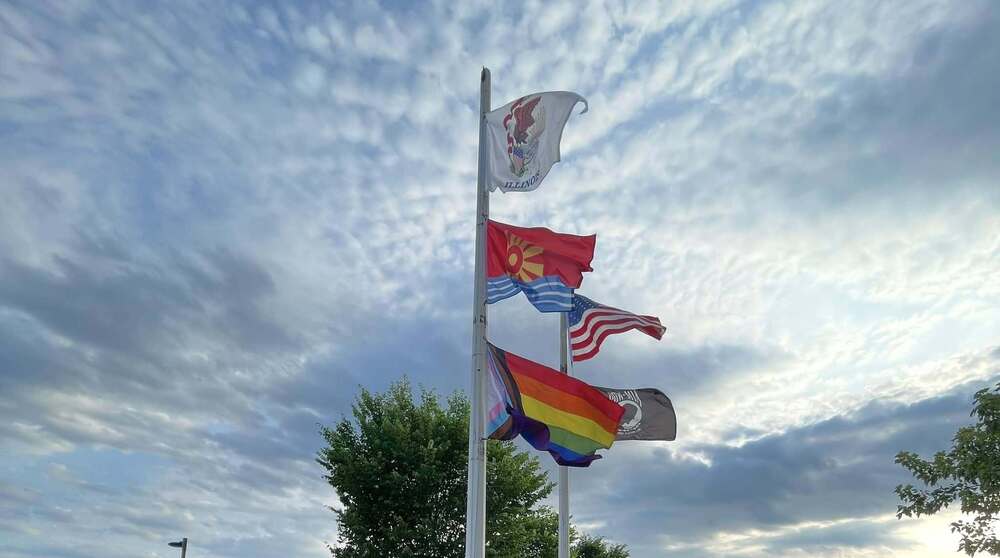
The City of Batavia will raise the Progress Pride flag at the corner of Island Ave. and Houston Street in recognition of Pride Month at 5:30 pm on Monday, June 1st, 2026.
This Pride Month is another during which queer people need all the help they can get, and while there are many who want to help, it can sometimes be hard to know where to start. How can you show your support in a meaningful way? Listed below are 13 practical things that you can do. Before we begin, we should recognize that the LGBTQIA+ community is not a monolith; all members and allies have different backgrounds, experiences, and opinions on everything discussed here. Therefore, this article should not be taken as fact, and I encourage you to continue to have conversations with queer people around you and continue to learn about their thoughts and experiences. In addition, each item and course of action discussed are individually the bare minimum, and they do not work if you only choose one or two items – strong allyship requires ongoing continuous action in a variety of ways. That said, the best thing you can do is be there for the people that you love; having a strong support system goes a long way on an individual level, something that is essential in this political climate. Take your time reading through these suggestions and be sure to check out the hyperlinks! Don’t try to consume it all at once. Learning should be enjoyable, so let’s have some fun!
1. Learn the Terms
The first steps in allyship of any form should always center your own education. There are many different labels under the queer umbrella and language people use every day. Language, including terms, definitions, and even the basic rules, constantly evolves, and some terms become outdated over time, so you should be open to a continuous education; there is always more to learn. GLAAD and HRC provide a good starting point, but there are also many more terms not listed as language is ever evolving. We should also recognize that many labels are merely umbrella terms, and even the people who use a common label have a wide variety of different experiences. Always be willing to learn about identities that are unfamiliar to you!
2. Learn About and Use Pronouns: Do’s & Don’t’s
Pronouns within the English language carry meaning that signifies gender, and while pronouns do not always equal gender, it is still important to use them properly as a sign of respect.
DO:
- Share your own pronouns
- Provide an option for others to share e.g. “If you are comfortable, would you like to share your pronouns?” or “If you would like to share your pronouns, you are welcome to do so.”
- It is okay to slip up (even transgender and non-binary people do it). What matters is how you catch yourself. DO apologize in the moment, but keep it short (e.g. “I’m sorry, I meant [correction]”, or “I apologize… [correction]”).
DON’T:
- DO NOT assume a person’s pronouns, even if they are cisgender.
- DO NOT require people to share pronouns. Some people may be uncomfortable in the environment for multiple reasons, including, but not limited to, feeling unsure about their identities or not feeling safe to share their pronouns due to the context. Additionally, some non-binary or agender people wish to be referred to only by name without pronoun usage. Finally, requiring sharing of pronouns can do more harm than good if a hostile, unfriendly, or non-supportive person is in the room. Keeping it optional allows a way out – most say nothing rather than choosing to cause a scene.
- When apologizing for a slip-up, DO NOT make it long. If it drags on, you might unintentionally make it about you. Emphasizing the mistake brings unwanted attention to it. The person affected more often than not would rather just move on quickly.
3. Learn About LGBTQIA+ History and Icons
The LGBTQIA+ community has a long history dating back to the ancient world, and even though you could spend an entire college course talking about one decade of queer history, it is often skipped over in our education system, with a paragraph or a page in a textbook at most. Even in the US alone, there is a long history of resistance and progress. Note that what I have listed is only a starting point. You should always be open to learning and actively seeking out knowledge. As I have hinted at, education that is not continuous can be a hindrance. Those who think they know it all are often the ones prone to making mistakes, even when they have good intentions.
- Queer icons in pop culture & history
- Queer activists & changemakers
- Mattachine Society and Daughters of Bilitis
- The origin of the Pink Triangle
- The Lavender Scare
- Learn about the history of Stonewall Uprising and Pride Month
- History of clothing policing targeting drag queens and genderqueer people. This dates back to the 19th Century.
- History of drag
- ACT UP and the fight against the AIDS crisis.
4. Seek Out Inclusive and Positive Queer Representation In All Forms of Media
Stories, both fiction and non-fiction, are powerful and can have the most impact on us. We should always seek out and share queer stories.
- Queer theory, literature, cinema, and archives
- TV Shows
- Movies
- Ask your friends for suggestions about stories you would enjoy.
- Ask a librarian where to find queer stories and books.
- Be aware of tropes, cliches, and stereotypes.
- Queer media can still lack diversity. Make sure to seek stories centering queer people of color.
5. Give Your Time and Money
It is important to give materially to the community – queer people need money to pay for food, housing, healthcare, and an education just like anyone else, but are often paid less, face higher rates of housing insecurity, and higher rates of food insecurity.
- Check out Queering the Burbs for events and shops local to our community.
- Everywhere is Queer has a map showing local queer-owned businesses.
- Give to advocacy groups such as The Trevor Project, HRC, ACLU, Lambda Legal, and more.
- Belong: Fox Valley provides a list of organizations offering a wide variety of services on the local, state, national, and international levels.
- Volunteer with organizations centering the queer community.
- Attending pride events is a form of giving your time.
6. Legislative Support
While Illinois scores high in its LGBTQIA+ policies, it is still important to continue to push for more supportive and against regressive policies. In 2025, there were 616 Anti-LGBTQ bills proposed across the US, including 15 from Illinois.
- National Women’s Law Center: By the Numbers
- Pew Research Center: Growing Support of Restrictions for Trans People
- Important issues happen at all levels of government. Nothing is too small.
- Contact your representatives! Elected officials, regardless of political party or political orientation, do not always vote in support of or against the interests of LGBTQIA+ individuals. Politics are often a game of numbers, which the LGBTQIA+ community would not have without allies.
- Check out Erin In The Morning to learn about topics, issues, and policies related to the LGBTQIA+ community, with an emphasis on transgender identities.
- ACLU and HRC sometimes provide quick actionable steps. For these and similar organizations, look for a “Take Action” tab to find opportunities to volunteer or quickly contact your representatives.
7. Address Stereotypes, Myths, Misconceptions and Bigotry
I cannot emphasize enough how important it is to address harmful rhetoric in the moment. However, we want to make sure we do it the right way. If not approached with tact, we risk escalating the situation or alienating someone. Our real goal is to use the moment as a learning opportunity. Here are some tips for approaching those conversations.
- Assume good intentions: sometimes, the person might not even realize that what they are saying is harmful and may even be trying to support queer individuals. Ask some clarifying questions to understand what they are trying to say before jumping to conclusions.
- Correct gently but do correct and speak with humility. It sometimes works to frame it as a common misconception, e.g. “You know, a lot of people think that, and I did too, but then I read this article that said…”
- Don’t assume identities or experiences: while much of the harmful rhetoric comes from a lack of information, that is not always the case. Let the person tell their story first. Context can sometimes change a seemingly harmful statement.
8. Social Media
- Avoid performative activism.
- Display your pronouns in your profile.
- Social media is a great place to learn from queer content creators and their stories.
- Seek existing posts in which people already openly discuss their experiences rather than asking people about their experiences. Some people might not want to talk about it, so it is better to find places where people already have.
- Report misinformation, disinformation, and hate instead of interacting with it. Commenting, liking, reposting, and/or sharing with others regardless of intent boosts the original post’s prevalence within the algorithm. The best course of action is to report false information.
- Be wary of seemingly supportive organizations and creators. Some can be misleading or may be allies only to certain parts of the community.
- Protect your peace. Hateful comments and posts often are intended to get a reaction out of you to boost engagement. Don’t feed it, just keep scrolling or take a break.
9. Visibility
- Contact theory: statistically, people are more likely to support the LGBTQIA+ community when they have met a queer person, and even more so if the person is close to them, such as a family member or close friend.
- Tell your stories and listen to the stories of others.
- Welcome stories from queer people AND ESPECIALLY trans people and ESPECIALLY queer and trans people of color.
- Show your pride: flags, pins, buttons (make sure you buy from queer-run businesses and advocacy groups).
- Time and place: know that there is not always a safe environment for queer visibility. Safety is the number one priority. Do not put yourself or anyone you care about in a potentially unsafe situation.
10. Learn About the Transition Process
Knowing about the actual process for seeking gender affirming care – socially, medically, and legally – can provide insight into the lives of trans people, including both the joys and the struggles. This can also be a helpful way to learn how to talk about many issues, topics, and policies that impact the transgender community. Below are some good starting points.
- What is Gender Affirming Care?
- Gender Affirming Care FAQs
- Hormone Replacement Therapy (HRT) impacts on trans athletes
- Feminizing HRT
- Masculinizing HRT
- Overview of Medical Gender Affirming Care
- Planned Parenthood: Learning about and finding care
- Gender & Name updates for IDs in Illinois
11. Attend Pride Events
- Check out Belong: Fox Valley for an upcoming calendar of local events!
- Remember that pride is not just a party, but a protest. Showing up matters.
- Show your support and love to the people around you.
- Have fun!
- Buy from vendors!
- You’re not there just for people to see that you’re there; you are there to give your support.
12. Mutual Aid
- What is mutual aid?
- The L comes first in LGBTQIA+ because of the Lesbian community’s contribution via mutual aid during the HIV epidemic of the 80s. Lesbian women would marry HIV-positive patients who could not legally marry their actual longtime partners. Marriage allowed access to hospital rooms and many other benefits that made a huge difference.
- Mutual aid today includes GoFundMe pages, food pantries, housing assistance, shelters, and more. This can be lifesaving when a queer person is suddenly displaced, which can be a result of discriminatory practices.
- Other forms of mutual aid focus on harm reduction, including providing free resources for safe sex including condoms, lube, Plan B, pregnancy tests, STI Screenings, and the like. Additionally, providing free clean needles can reduce the risk and spread of HIV, and providing free Narcan/Naloxone makes the difference between life and death.
13. Deconstruct Your Own Biases
You may have noticed that each of the methods of support listed involve education or deconstruction of biases. We all have these biases and should always work to deconstruct them within our own lives. Think about where it comes from, the harm it can cause, and how you can improve going forward. Biases can come from the gender binary, patriarchy, white supremacy, internalized homophobia, and more. Try to view issues through an intersectional lens to recognize that certain topics can impact different groups and subgroups of identities in various ways. It is okay to make mistakes. What matters is that we are always striving to improve.
This pride month and beyond, be sure to take action to support the queer community. This is a scary time for queer individuals, but it is also a time for joy and for love. Keep celebrating while showing your support. Being there, being joyful, and showing your love can be an unexpected source of inspiration for many. Best of luck and happy pride!